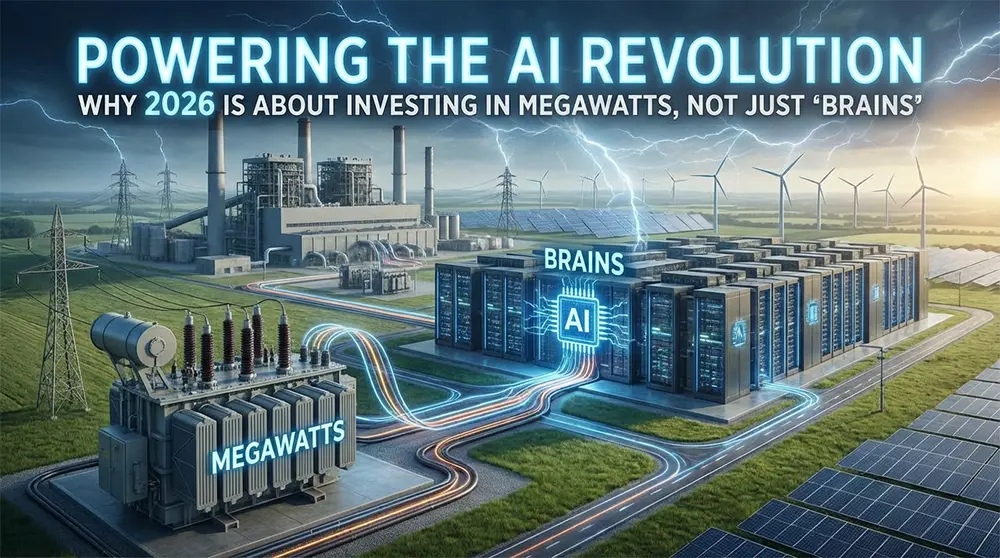
In 2026, the investment focus is shifting perceptibly. While AI remains the dominant growth story, real capital is increasingly flowing to where AI "touches the ground"—into electricity, grids, cooling systems, and physical infrastructure. If 2024–2025 was the race for computation, 2026 is becoming the race for reliable power and physical capacity.
Why AI Has Hit the 'Electricity Wall'
Large models and data centers require not just chips, but a stable power supply that cannot be scaled as rapidly as software. Consequently, infrastructure constraints are moving to the forefront: grid connections, transformers, construction, and cooling—elements that rarely make headlines but ultimately determine the industry's growth speed.
This gives rise to a new investment thesis: the "AI Revolution" is now simultaneously a technological and an energy project.
The 'Nuclear Renaissance' as an Answer to Data Center Demand
One of the most discussed narratives at the intersection of energy and technology is the return of nuclear generation as a source of 24/7, low-carbon baseload power. Analysis from late 2025 explicitly links nuclear energy to the surging demand from AI infrastructure and capacity expansion (including new projects).
Particular emphasis is placed on Small Modular Reactors (SMRs) and the "energy-tech" alliance, where new computational loads become the catalyst for accelerating energy solutions. Crucially, the market isn't buying "nuclear" as an ideology, but rather the predictability of generation and contract models capable of withstanding the multi-year investment cycles of data centers.
Where Yield Can Be Found: 4 Key Directions
Below is the logic by which investors in 2026 are increasingly breaking down the "Power for AI" theme into distinct buckets.
1) Power Grids and Infrastructure Modernization
While generation can be "added" via projects, the grid remains a bottleneck: connecting new capacity, building substations, equipment shortages, and implementation timelines.
The winners here are businesses selling not the kilowatt-hour itself, but the "ability to deliver the kilowatt-hour"—grid operators, contractors, and manufacturers of transmission and distribution equipment.
Investment Rationale: Grids often have indexed tariffs and regulated returns, making them akin to "infrastructure bonds," but within the equity market.
2) '24/7' Generation and Long-Term Contracts
The growing load from data centers is pushing the market toward energy sources that provide baseload power independent of weather conditions. This is why the nuclear theme looks "institutional" again—not as a trendy fad, but as a long-term bet on structural demand from the digital economy.
Investment Rationale: Focus on companies/projects that know how to monetize reliability through long-term contracts (PPAs), rather than those simply "producing electricity."
3) Data Centers as 'The New Real Estate'
AI requires not just energy, but space, logistics, cooling, and redundancy. In practice, this transforms data centers into a distinct asset class where access to the grid and the cost of capital are critical.
Investment Rationale: Yield can be generated through capacity leasing, high occupancy rates, and growing demand for premium sites adjacent to energy hubs.
4) AI Phase 2: Capex over Software
Market outlooks for 2026 highlight a changing playbook: holding only AI software stocks is no longer sufficient; attention is shifting to alternatives and real assets that service the technological cycle. The growth story is spreading down the value chain—from computation to capital expenditures (Capex) and infrastructure.
Investment Rationale: A broader set of beneficiaries, but with higher selection requirements (balance sheet strength, debt load, access to financing, regulatory risks).
Key Risks in 2026 (And How to Think About Them)
Timelines and Permitting: Energy and grid projects rarely fit into "quarterly expectations," meaning re-ratings can be followed by disappointment even within a correct long-term trend.
Politics and Regulation: The nuclear and grid agenda cannot be separated from the state: tariffs, permits, public support, and safety all impact the cost of capital and timelines.
Demand Concentration: If demand for capacity is too heavily tied to a few hyperscalers, the negotiating power of the energy buyer/tenant could pressure margins.
Practical Conclusion for the Investor
In 2026, "betting on AI" increasingly means not picking the next winner among software companies, but building exposure to the infrastructure layer: electricity, grids, and physical capacity.
There is less hype here, but often more predictability—and this is exactly what the market begins to value when a technological cycle transitions from the phase of promises to the phase of multi-year capital deployment.