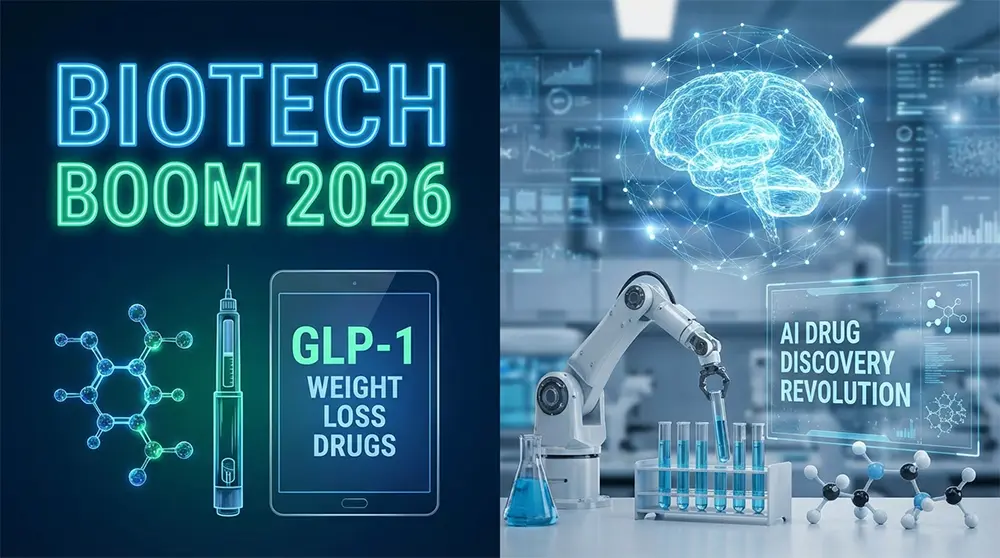
While technology stocks have dominated headlines, biotech is quietly positioning for one of its strongest years in a decade. Lower interest rates, a maturing pipeline of blockbuster GLP-1 obesity drugs, and artificial intelligence transforming drug discovery are creating a perfect storm for healthcare innovation. In 2026, biotech isn't just about healthspan—it's about trillion-dollar market opportunities.
The GLP-1 Gold Rush: A $150 Billion Market by Decade's End
GLP-1 receptor agonists—once niche diabetes treatments—are now the fastest-growing pharmaceutical category in history. Originally developed for Type 2 diabetes, drugs like semaglutide (Ozempic/Wegovy) and tirzepatide (Mounjaro) have unlocked unprecedented demand for obesity treatment, with over 12% of U.S. adults now using these medications.
The numbers are staggering. Analysts project the global GLP-1 market will reach $150 billion annually by 2030, rivaling the entire oncology market today. What began as a diabetes franchise has expanded into cardiovascular protection, kidney disease, Alzheimer's prevention, and addiction treatment—creating multiple billion-dollar indications from a single molecular mechanism.
Novo Nordisk and Eli Lilly, the undisputed GLP-1 leaders, are executing flawlessly. Novo reports 1.5 million new Wegovy patients in Q4 2025 alone, while Lilly's manufacturing expansion will triple tirzepatide supply by mid-2026. These aren't speculative biotech plays; they're global pharmaceutical giants with durable competitive moats.
AI Drug Discovery: Cutting 10 Years Off Development Timelines
The real game-changer for 2026 is artificial intelligence's penetration into drug discovery. Traditional small-molecule development takes 12-15 years and costs $2.6 billion per approved drug. AI platforms are compressing both metrics dramatically.
Major tech-pharma partnerships are accelerating:
- Schrödinger + NVIDIA: Physics-based AI models screening billions of compounds daily
- Insilico Medicine: AI-discovered targets entering Phase II trials in 2026
- Recursion Pharmaceuticals: Training models on 25 petabytes of cellular imagery
The impact is measurable. AI-discovered drugs now comprise 15% of clinical pipeline assets, up from 2% in 2023. Success rates for AI-originated candidates are 30% higher than traditional approaches, creating a virtuous cycle of capital allocation toward computational biology.
M&A Frenzy: Big Pharma's $200 Billion War Chest
With patent cliffs looming and R&D productivity stagnant, large pharmaceutical companies are sitting on unprecedented cash reserves. 2026 M&A activity is forecast to exceed $200 billion, focused on three priorities:
- GLP-1 Pipeline Depth: Securing next-generation oral formulations and combination therapies
- AI Drug Platforms: Acquiring computational discovery engines rather than individual molecules
- Cell/Gene Therapy Manufacturing: Buying capacity to scale approved therapies like CAR-T
Pfizer's $43 billion Seagen acquisition in 2023 set the tone. In 2026, expect multiple $10-20 billion deals targeting mid-cap biotechs with Phase III GLP-1 candidates or differentiated AI platforms. The arbitrage opportunity is clear: public biotech valuations remain depressed relative to private AI-drug discovery exits.
Investment Roadmap: Where Alpha Lives in 2026
The Blockbuster Makers (Core Holdings):
- Novo Nordisk (NVO) - GLP-1 monopoly, pipeline diversification
- Eli Lilly (LLY) - Manufacturing scale + Alzheimer's pipeline
- Viking Therapeutics (VKTX) - Next-gen GLP-1 oral candidates
AI Drug Discovery Picks (High Beta):
- Recursion (RXRX) - Largest multimodal bio dataset
- Absci (ABSI) - Generative AI for novel biologics
- Schrödinger (SDGR) - Physics + ML hybrid platform
M&A Catalysts (Event-Driven):
- $5-15B market cap biotechs with Phase III GLP-1 data readouts
- AI platforms with Big Pharma partnership milestones
- Gene therapy CMOs with approved commercial products
The Valuation Reset: Biotech at 12x Forward Earnings
After three years of pain, biotech multiples are resetting to historically attractive levels. The NASDAQ Biotechnology Index trades at 12x 2026 forward earnings—versus the S&P 500's 22x—despite superior growth prospects. The sector offers a rare combination of defensive stability (healthcare demand is recession-proof) and asymmetric upside (blockbuster drug launches).
Risk/reward remains compelling:
- Downside: 20-30% from current levels (historical trough multiple)
- Base Case: 50% upside as M&A accelerates and GLP-1 revenue compounds
- Bull Case: 100%+ for AI-biotech hybrids acquired by Big Tech/Pharma
Regulatory Tailwinds: FDA Efficiency + International Approvals
The FDA's modernized approach under new leadership is accelerating approvals. Real-time manufacturing inspections, AI trial design guidance, and harmonized EU/U.S. standards are reducing approval timelines by 6-12 months. China's CDE is approving GLP-1 generics faster than expected, creating parallel U.S. market opportunities through 505(b)(2) pathways.
The 2026 Biotech Thesis
Biotech in 2026 offers three layered investment opportunities:
- Proven Blockbusters: Collect GLP-1 royalties while waiting for pipeline optionality
- AI Infrastructure: Own the picks-and-shovels powering 21st-century drug discovery
- M&A Catalysts: Position for $200B in takeout premiums
This isn't 2021 speculative biotech. It's a convergence of validated science (GLP-1), transformative technology (AI discovery), and forced M&A (Big Pharma desperation). For patient capital, 2026 represents biotech's decade-defining moment—a sector pivot from survival to dominance.